Modest cell lung cancer is a illness in which cancerous (cancer) cells course in the tissues of the lung.
There are two chief types of small-scale cell lung cancer.
Smoking is the major risk factor for pocket-sized cell lung cancer.
Signs and symptoms of small-scale jail cell lung cancer include coughing and shortness of breath.
Tests and procedures that examine the lungs are used to diagnose and stage small cell lung cancer.
Certain factors bear on prognosis (adventure of recovery) and treatment options.
For most patients with minor cell lung cancer, electric current treatments exercise non cure the cancer.
Pocket-sized cell lung cancer is a disease in which malignant (cancer) cells form in the tissues of the lung.
The lungs are a pair of cone-shaped breathing organs that are found in the chest. The lungs bring oxygen into the torso when yous breathe in and take out carbon dioxide when y'all breathe out. Each lung has sections called lobes. The left lung has ii lobes. The right lung, which is slightly larger, has three. A thin membrane chosen the pleura surrounds the lungs. 2 tubes called bronchi lead from the trachea (windpipe) to the right and left lungs. The bronchi are sometimes also affected by lung cancer. Small tubes called bronchioles and tiny air sacs called alveoli brand up the within of the lungs.
EnlargeBeefcake of the respiratory system, showing the trachea and both lungs and their lobes and airways. Lymph nodes and the diaphragm are likewise shown. Oxygen is inhaled into the lungs and passes through the sparse membranes of the alveoli and into the bloodstream (see inset).
There are two types of lung cancer: small jail cell lung cancer and non-small prison cell lung cancer.
This summary is about small cell lung cancer and its treatment. Run into the post-obit PDQ summaries for more data about lung cancer:
At that place are ii main types of pocket-size prison cell lung cancer.
These two types include many different types of cells. The cancer cells of each type grow and spread in different ways. The types of small jail cell lung cancer are named for the kinds of cells found in the cancer and how the cells look when viewed under a microscope:
Smoking is the major adventure gene for small prison cell lung cancer.
Anything that increases your run a risk of getting a disease is called a gamble gene. Having a risk factor does not hateful that yous will get cancer; not having risk factors doesn't mean that you lot will non get cancer. Talk to your dr. if you remember you may be at risk for lung cancer.
Risk factors for lung cancer include the following:
Smoking cigarettes, pipes, or cigars, at present or in the past. This is the most important risk cistron for lung cancer. The earlier in life a person starts smoking, the more often a person smokes, and the more years a person smokes, the greater the risk of lung cancer.
Beingness exposed to secondhand smoke.
Beingness exposed to asbestos, arsenic, chromium, beryllium, nickel, soot, or tar in the workplace.
Being exposed to radiation from any of the post-obit:
Radiation therapy to the breast or breast.
Radon in the home or workplace.
Imaging tests such as CT scans.
Atomic bomb radiation.
Living where at that place is air pollution.
Having a family unit history of lung cancer.
Beingness infected with the human immunodeficiency virus (HIV).
Taking beta carotene supplements and existence a heavy smoker.
Older historic period is the main adventure gene for most cancers. The take a chance of getting cancer increases as you get older.
When smoking is combined with other gamble factors, the risk of lung cancer is increased.
Signs and symptoms of small prison cell lung cancer include coughing and shortness of breath.
These and other signs and symptoms may be caused past small cell lung cancer or by other conditions. Cheque with your doctor if you have any of the following:
Chest discomfort or pain.
A cough that doesn't go away or gets worse over fourth dimension.
Problem breathing.
Wheezing.
Blood in sputum (mucus coughed up from the lungs).
Hoarseness.
Trouble swallowing.
Loss of appetite.
Weight loss for no known reason.
Feeling very tired.
Swelling in the confront and/or veins in the neck.
Tests and procedures that examine the lungs are used to diagnose and stage small prison cell lung cancer.
The following tests and procedures may exist used:
Physical exam and health history: An exam of the body to check general signs of health, including checking for signs of disease, such equally lumps or anything else that seems unusual. A history of the patient'due south wellness habits, including smoking, and by jobs, illnesses, and treatments will also be taken.
Laboratory tests: Medical procedures that exam samples of tissue, blood, urine, or other substances in the body. These tests assist to diagnose disease, program and cheque treatment, or monitor the disease over time.
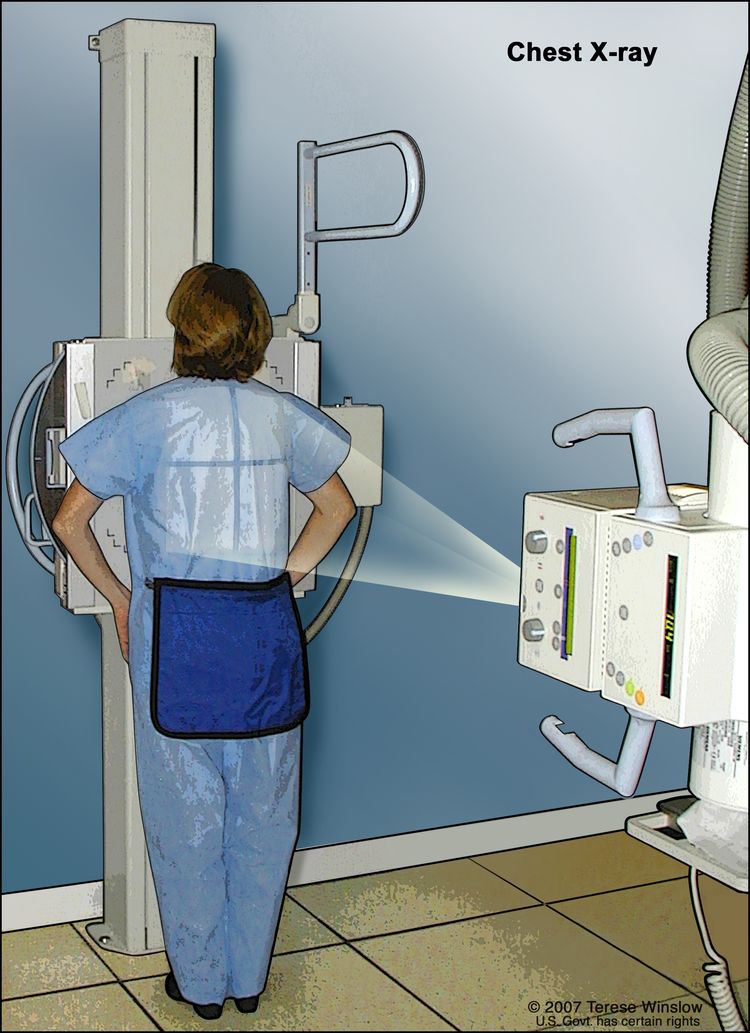
Breast x-ray: An x-ray of the organs and bones inside the chest. An ten-ray is a type of energy axle that can go through the torso and onto film, making a moving picture of areas within the torso.Overstate10-ray of the breast. X-rays are used to have pictures of organs and basic of the chest. X-rays pass through the patient onto film.
CT browse (CAT scan) of the encephalon, chest, and abdomen: A procedure that makes a series of detailed pictures of areas inside the body, taken from different angles. The pictures are made by a computer linked to an x-ray machine. A dye may be injected into a vein or swallowed to help the organs or tissues show up more conspicuously. This process is also called computed tomography, computerized tomography, or computerized axial tomography.
Sputum cytology: A microscope is used to cheque for cancer cells in the sputum (mucus coughed upwardly from the lungs).
Biopsy: The removal of cells or tissues so they tin can be viewed under a microscope by a pathologist to check for signs of cancer. The different ways a biopsy can be washed include the following:
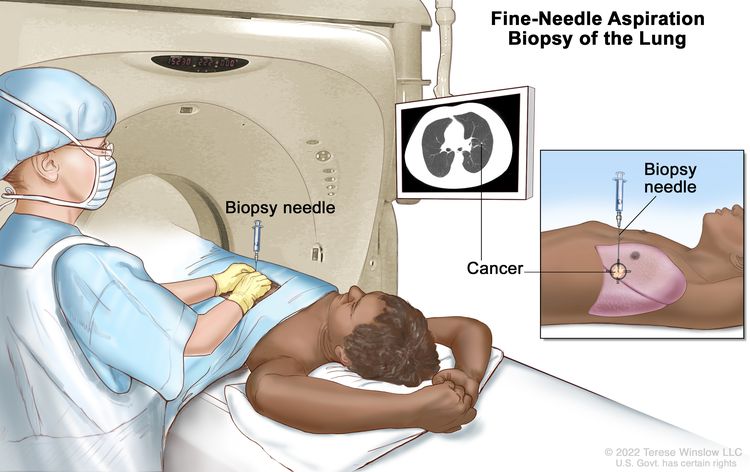
Fine-needle aspiration (FNA) biopsy of the lung: The removal of tissue or fluid from the lung, using a sparse needle. A CT browse, ultrasound, or other imaging process is used to find the abnormal tissue or fluid in the lung. A minor incision may be made in the skin where the biopsy needle is inserted into the abnormal tissue or fluid. A sample is removed with the needle and sent to the laboratory. A pathologist then views the sample nether a microscope to wait for cancer cells. A chest x-ray is washed after the process to brand sure no air is leaking from the lung into the chest.EnlargeFine-needle aspiration biopsy of the lung. The patient lies on a table that slides through the computed tomography (CT) machine, which takes x-ray pictures of the within of the body. The x-ray pictures assist the doctor see where the aberrant tissue is in the lung. A biopsy needle is inserted through the breast wall and into the area of abnormal lung tissue. A small-scale piece of tissue is removed through the needle and checked under the microscope for signs of cancer.
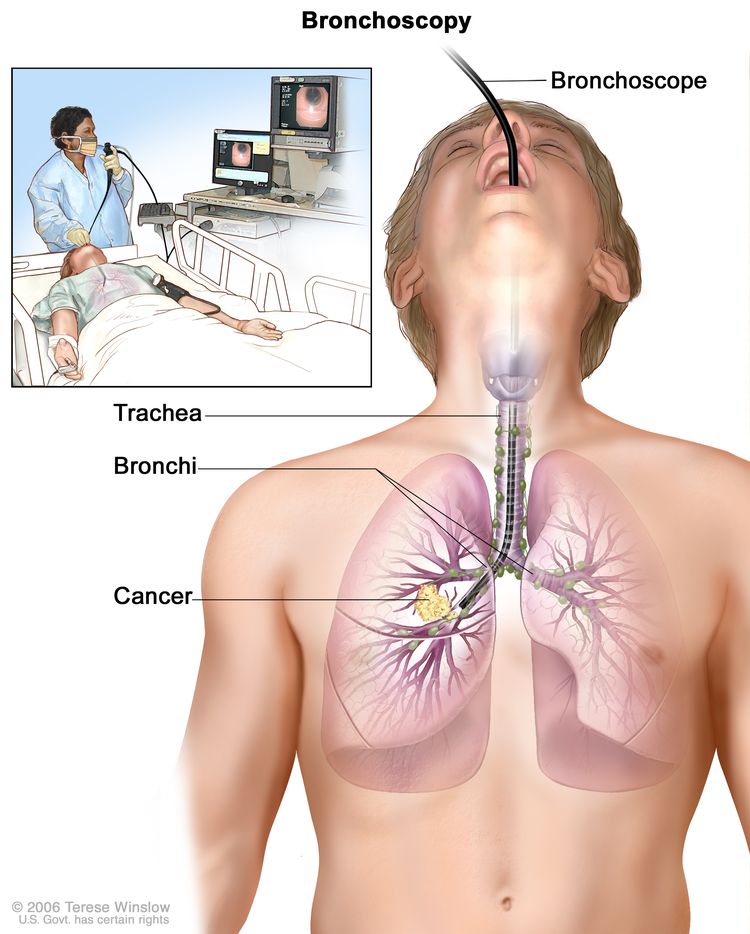
Bronchoscopy: A process to look inside the trachea and big airways in the lung for abnormal areas. A bronchoscope is inserted through the nose or mouth into the trachea and lungs. A bronchoscope is a thin, tube-similar instrument with a light and a lens for viewing. It may also have a tool to remove tissue samples, which are checked under a microscope for signs of cancer. EnlargeBronchoscopy. A bronchoscope is inserted through the rima oris, trachea, and major bronchi into the lung, to look for abnormal areas. A bronchoscope is a sparse, tube-similar musical instrument with a light and a lens for viewing. Information technology may also have a cutting tool. Tissue samples may exist taken to be checked under a microscope for signs of disease.
Thoracoscopy: A surgical process to await at the organs within the breast to cheque for abnormal areas. An incision (cutting) is made between two ribs, and a thoracoscope is inserted into the chest. A thoracoscope is a sparse, tube-like instrument with a light and a lens for viewing. Information technology may likewise have a tool to remove tissue or lymph node samples, which are checked nether a microscope for signs of cancer. In some cases, this procedure is used to remove part of the esophagus or lung. If certain tissues, organs, or lymph nodes tin can't be reached, a thoracotomy may be washed. In this procedure, a larger incision is fabricated between the ribs and the chest is opened.
Thoracentesis: The removal of fluid from the infinite between the lining of the breast and the lung, using a needle. A pathologist views the fluid under a microscope to expect for cancer cells.
Mediastinoscopy: A surgical procedure to look at the organs, tissues, and lymph nodes betwixt the lungs for abnormal areas. An incision (cutting) is made at the top of the breastbone and a mediastinoscope is inserted into the chest. A mediastinoscope is a thin, tube-like instrument with a light and a lens for viewing. Information technology may also take a tool to remove tissue or lymph node samples, which are checked under a microscope for signs of cancer.
Light and electron microscopy: A laboratory test in which cells in a sample of tissue are viewed nether regular and high-powered microscopes to wait for certain changes in the cells.
Immunohistochemistry: A laboratory exam that uses antibodies to check for sure antigens (markers) in a sample of a patient's tissue. The antibodies are usually linked to an enzyme or a fluorescent dye. Subsequently the antibodies bind to a specific antigen in the tissue sample, the enzyme or dye is activated, and the antigen tin can and then be seen under a microscope. This type of test is used to help diagnose cancer and to help tell one type of cancer from another blazon of cancer.
Certain factors affect prognosis (chance of recovery) and treatment options.
The prognosis and treatment options depend on the post-obit:
The stage of the cancer (whether information technology is in the breast cavity only or has spread to other places in the trunk).
The patient's age, gender, and general health.
For certain patients, prognosis also depends on whether the patient is treated with both chemotherapy and radiation.
For well-nigh patients with small cell lung cancer, current treatments practice non cure the cancer.
If lung cancer is found, patients should call up about taking function in i of the many clinical trials being done to improve treatment. Clinical trials are taking place in most parts of the state for patients with all stages of small-scale prison cell lung cancer. Information about ongoing clinical trials is available from the NCI website.
Stages of Small Cell Lung Cancer
Central Points
After modest cell lung cancer has been diagnosed, tests are done to find out if cancer cells take spread inside the chest or to other parts of the trunk.
There are three ways that cancer spreads in the torso.
Cancer may spread from where it began to other parts of the torso.
The following stages are used for small cell lung cancer:
Limited-Stage Pocket-size Cell Lung Cancer
Extensive-Stage Pocket-sized Cell Lung Cancer
Pocket-sized cell lung cancer can recur (come back) after it has been treated.
After small cell lung cancer has been diagnosed, tests are washed to discover out if cancer cells have spread inside the chest or to other parts of the body.
The process used to notice out if cancer has spread within the chest or to other parts of the body is chosen staging. The information gathered from the staging procedure determines the phase of the illness. It is important to know the phase in order to plan handling. Some of the tests used to diagnose small prison cell lung cancer are also used to stage the disease. (See the General Information section.)
Other tests and procedures that may be used in the staging process include the following:
MRI (magnetic resonance imaging) of the brain: A procedure that uses a magnet, radio waves, and a computer to make a serial of detailed pictures of areas within the body. This procedure is also called nuclear magnetic resonance imaging (NMRI).
CT scan (True cat scan): A procedure that makes a series of detailed pictures of areas inside the trunk, such as the brain, breast or upper belly, taken from different angles. The pictures are made by a figurer linked to an 10-ray machine. A dye may exist injected into a vein or swallowed to help the organs or tissues evidence up more conspicuously. This procedure is likewise called computed tomography, computerized tomography, or computerized axial tomography.
PET scan (positron emission tomography scan): A process to find malignant tumor cells in the body. A small amount of radioactive glucose (sugar) is injected into a vein. The PET scanner rotates around the body and makes a motion picture of where glucose is being used in the trunk. Malignant tumor cells bear witness up brighter in the picture because they are more than agile and have up more glucose than normal cells do. A PET browse and CT scan may be done at the same time. This is chosen a PET-CT.
Bone scan: A process to bank check if in that location are quickly dividing cells, such every bit cancer cells, in the os. A very pocket-sized amount of radioactive material is injected into a vein and travels through the bloodstream. The radioactive material collects in the bones with cancer and is detected past a scanner.
There are three ways that cancer spreads in the torso.
Cancer can spread through tissue, the lymph system, and the claret:
Tissue. The cancer spreads from where it began by growing into nearby areas.
Lymph system. The cancer spreads from where information technology began past getting into the lymph organisation. The cancer travels through the lymph vessels to other parts of the body.
Blood. The cancer spreads from where it began by getting into the blood. The cancer travels through the blood vessels to other parts of the body.
Cancer may spread from where information technology began to other parts of the body.
When cancer spreads to another office of the body, it is called metastasis. Cancer cells interruption away from where they began (the master tumor) and travel through the lymph organization or blood.
Lymph system. The cancer gets into the lymph organization, travels through the lymph vessels, and forms a tumor (metastatic tumor) in another function of the torso.
Claret. The cancer gets into the blood, travels through the blood vessels, and forms a tumor (metastatic tumor) in another role of the body.
The metastatic tumor is the same type of cancer as the main tumor. For example, if small cell lung cancer spreads to the brain, the cancer cells in the brain are really lung cancer cells. The disease is metastatic small prison cell lung cancer, not encephalon cancer.
Many cancer deaths are caused when cancer moves from the original tumor and spreads to other tissues and organs. This is called metastatic cancer. This animation shows how cancer cells travel from the identify in the trunk where they get-go formed to other parts of the body.
The following stages are used for minor cell lung cancer:
Limited-Phase Pocket-sized Cell Lung Cancer
In limited-stage, cancer is in the lung where it started and may have spread to the area betwixt the lungs or to the lymph nodes above the collarbone.
All-encompassing-Phase Small Jail cell Lung Cancer
In all-encompassing-stage, cancer has spread beyond the lung or the expanse between the lungs or the lymph nodes above the collarbone to other places in the trunk.
Small jail cell lung cancer can recur (come up back) subsequently it has been treated.
The cancer may come back in the breast, central nervous system, or in other parts of the body.
Handling Pick Overview
Central Points
There are dissimilar types of treatment for patients with small cell lung cancer.
Six types of standard handling are used:
Surgery
Chemotherapy
Radiation therapy
Immunotherapy
Light amplification by stimulated emission of radiation therapy
Endoscopic stent placement
New types of treatment are existence tested in clinical trials.
Treatment for pocket-sized cell lung cancer may crusade side effects.
Patients may want to recall about taking office in a clinical trial.
Patients tin can enter clinical trials earlier, during, or after starting their cancer treatment.
Follow-up tests may be needed.
In that location are different types of treatment for patients with pocket-size cell lung cancer.
Different types of treatment are bachelor for patients with small cell lung cancer. Some treatments are standard (the currently used treatment), and some are being tested in clinical trials. A treatment clinical trial is a research study meant to assist improve current treatments or obtain data on new treatments for patients with cancer. When clinical trials bear witness that a new treatment is better than the standard treatment, the new treatment may become the standard treatment. Patients may want to think about taking part in a clinical trial. Some clinical trials are open simply to patients who have not started treatment.
Half-dozen types of standard treatment are used:
Surgery
Surgery may be used if the cancer is found in one lung and in nearby lymph nodes only. Because this blazon of lung cancer is unremarkably institute in both lungs, surgery alone is non oftentimes used. During surgery, the doc will also remove lymph nodes to discover out if they have cancer in them. Sometimes, surgery may be used to remove a sample of lung tissue to find out the exact type of lung cancer.
After the doctor removes all the cancer that tin be seen at the fourth dimension of the surgery, some patients may exist given chemotherapy or radiations therapy later on surgery to impale whatever cancer cells that are left. Treatment given after the surgery, to lower the adventure that the cancer will come dorsum, is called adjuvant therapy.
Chemotherapy
Chemotherapy is a cancer treatment that uses drugs to stop the growth of cancer cells, either past killing the cells or by stopping them from dividing. When chemotherapy is taken by rima oris or injected into a vein or muscle, the drugs enter the bloodstream and can reach cancer cells throughout the body (systemic chemotherapy). When chemotherapy is placed straight into the cerebrospinal fluid, an organ, or a body cavity such as the abdomen, the drugs mainly bear upon cancer cells in those areas (regional chemotherapy). The way the chemotherapy is given depends on the type and stage of the cancer being treated.
Run into Drugs Approved for Small Jail cell Lung Cancer for more information.
Radiation therapy
Radiation therapy is a cancer treatment that uses loftier-energy x-rays or other types of radiation to kill cancer cells or go on them from growing. External radiation therapy uses a machine outside the body to send radiation toward the area of the body with cancer. External radiation therapy is used to treat small cell lung cancer, and may likewise be used as palliative therapy to salvage symptoms and better quality of life. Radiation therapy to the encephalon to lessen the risk that cancer will spread to the brain may also exist given.
Immunotherapy
Immunotherapy is a treatment that uses the patient'due south immune system to fight cancer. Substances made by the torso or fabricated in a laboratory are used to boost, direct, or restore the body's natural defenses against cancer. This cancer treatment is a type of biologic therapy.
Immune checkpoint inhibitor therapy is a type of immunotherapy used to treat some patients with avant-garde small-scale-prison cell lung cancer.
Types of immune checkpoint inhibitor therapy include:
PD-ane and PD-L1 inhibitor therapy: PD-one is a protein on the surface of T cells that helps proceed the body's immune responses in bank check. PD-L1 is a protein found on some types of cancer cells. When PD-1 attaches to PD-L1, it stops the T cell from killing the cancer cell. PD-1 and PD-L1 inhibitors proceed PD-1 and PD-L1 proteins from attaching to each other. This allows the T cells to kill cancer cells. Atezolizumab and durvalumab are types of PD-L1 inhibitors.
Immunotherapy uses the torso's immune system to fight cancer. This animation explains ane type of immunotherapy that uses allowed checkpoint inhibitors to treat cancer.
See Drugs Approved for Small Cell Lung Cancer for more than data.
Laser therapy
Laser therapy is a cancer treatment that uses a laser beam (a narrow beam of intense light) to kill cancer cells.
Endoscopic stent placement
An endoscope is a thin, tube-similar musical instrument used to look at tissues within the body. An endoscope has a calorie-free and a lens for viewing and may be used to place a stent in a body structure to go along the structure open. An endoscopic stent can be used to open up an airway blocked by abnormal tissue.
New types of treatment are being tested in clinical trials.
Information about clinical trials is available from the NCI website.
Treatment for small prison cell lung cancer may cause side effects.
For information near side effects acquired by treatment for cancer, run into our Side Effects page.
Patients may want to call up about taking role in a clinical trial.
For some patients, taking part in a clinical trial may be the best treatment choice. Clinical trials are part of the cancer enquiry process. Clinical trials are done to notice out if new cancer treatments are safety and effective or better than the standard treatment.
Many of today'south standard treatments for cancer are based on earlier clinical trials. Patients who have part in a clinical trial may receive the standard treatment or be amidst the get-go to receive a new handling.
Patients who take part in clinical trials also assistance meliorate the way cancer volition be treated in the hereafter. Even when clinical trials practice not lead to constructive new treatments, they ofttimes answer of import questions and assistance move research forward.
Patients can enter clinical trials before, during, or after starting their cancer treatment.
Some clinical trials only include patients who have non yet received handling. Other trials test treatments for patients whose cancer has not gotten better. There are likewise clinical trials that test new ways to terminate cancer from recurring (coming dorsum) or reduce the side effects of cancer treatment.
Clinical trials are taking place in many parts of the country. Information virtually clinical trials supported by NCI can exist found on NCI'southward clinical trials search webpage. Clinical trials supported by other organizations can exist institute on the ClinicalTrials.gov website.
Some of the tests that were done to diagnose the cancer or to discover out the stage of the cancer may exist repeated. Some tests will be repeated in society to come across how well the treatment is working. Decisions about whether to go on, change, or finish treatment may be based on the results of these tests.
Some of the tests will continue to exist washed from time to fourth dimension after treatment has concluded. The results of these tests can evidence if your status has inverse or if the cancer has recurred (come back). These tests are sometimes called follow-upwardly tests or bank check-ups.
Follow-up tests may be needed.
Treatment of Limited-Phase Small Prison cell Lung Cancer
Treatment of Extensive-Phase Small-scale Cell Lung Cancer
Treatment of Recurrent Pocket-sized Jail cell Lung Cancer
To Larn More Well-nigh Pocket-sized Jail cell Lung Cancer
For more information from the National Cancer Constitute well-nigh small jail cell lung cancer, run across the following:
For general cancer information and other resources from the National Cancer Plant, see the post-obit:
About This PDQ Summary
About PDQ
Physician Data Query (PDQ) is the National Cancer Establish's (NCI'southward) comprehensive cancer information database. The PDQ database contains summaries of the latest published information on cancer prevention, detection, genetics, treatment, supportive care, and complementary and alternative medicine. Most summaries come in ii versions. The health professional person versions take detailed information written in technical linguistic communication. The patient versions are written in easy-to-understand, nontechnical linguistic communication. Both versions have cancer information that is accurate and up to date and most versions are also available in Spanish.
PDQ is a service of the NCI. The NCI is office of the National Institutes of Health (NIH). NIH is the federal government's heart of biomedical inquiry. The PDQ summaries are based on an independent review of the medical literature. They are not policy statements of the NCI or the NIH.
Purpose of This Summary
This PDQ cancer information summary has current data about the treatment of small-scale cell lung cancer. Information technology is meant to inform and help patients, families, and caregivers. It does not give formal guidelines or recommendations for making decisions nearly health care.
Reviewers and Updates
Editorial Boards write the PDQ cancer data summaries and keep them up to date. These Boards are made up of experts in cancer handling and other specialties related to cancer. The summaries are reviewed regularly and changes are made when there is new data. The appointment on each summary ("Updated") is the date of the most contempo change.
The information in this patient summary was taken from the wellness professional person version, which is reviewed regularly and updated as needed, by the PDQ Adult Treatment Editorial Lath.
Clinical Trial Information
A clinical trial is a study to answer a scientific question, such every bit whether one treatment is better than some other. Trials are based on past studies and what has been learned in the laboratory. Each trial answers certain scientific questions in order to find new and meliorate ways to help cancer patients. During handling clinical trials, information is collected about the effects of a new treatment and how well it works. If a clinical trial shows that a new handling is better than i currently being used, the new treatment may become "standard." Patients may want to recall well-nigh taking part in a clinical trial. Some clinical trials are open just to patients who have not started treatment.
Clinical trials tin can be found online at NCI'south website. For more information, call the Cancer Information Service (CIS), NCI'southward contact centre, at one-800-4-CANCER (1-800-422-6237).
Permission to Use This Summary
PDQ is a registered trademark. The content of PDQ documents can be used freely every bit text. It cannot be identified equally an NCI PDQ cancer information summary unless the whole summary is shown and it is updated regularly. All the same, a user would be allowed to write a sentence such as "NCI's PDQ cancer information summary about breast cancer prevention states the risks in the post-obit way: [include extract from the summary]."
The all-time way to cite this PDQ summary is:
PDQ® Adult Treatment Editorial Board. PDQ Pocket-size Prison cell Lung Cancer Treatment. Bethesda, MD: National Cancer Plant. Updated <MM/DD/YYYY>. Available at: https://world wide web.cancer.gov/types/lung/patient/small-scale-cell-lung-treatment-pdq. Accessed <MM/DD/YYYY>. [PMID: 26389478]
Images in this summary are used with permission of the author(s), creative person, and/or publisher for apply in the PDQ summaries only. If you desire to use an image from a PDQ summary and you are not using the whole summary, you must go permission from the owner. It cannot be given past the National Cancer Institute. Information virtually using the images in this summary, along with many other images related to cancer tin exist found in Visuals Online. Visuals Online is a collection of more 3,000 scientific images.
Disclaimer
The information in these summaries should non be used to make decisions nigh insurance reimbursement. More data on insurance coverage is available on Cancer.gov on the Managing Cancer Care page.
Contact Us
More information about contacting u.s. or receiving help with the Cancer.gov website can be found on our Contact United states of america for Help page. Questions can also be submitted to Cancer.gov through the website's Eastward-mail Us.

0 Response to "Baby Birthed to Give Organs to Cancer Patient Movie"
Post a Comment